On the occasion of World Migrants Day, celebrated every 18 December, we will review this phenomenon here. We analyse its causes, its past, its present and its future, trying to reach a conclusion about its impact on migration laws.
Viviana Echeverria
By Viviana Echeverria
Published in Legal news
,
16 December 2025.
Last Updated: 23 December 2025
Since time immemorial, the search for better opportunities in life has been the inherent goal of all migration projects. In the dawn of humanity, it was their nomadic nature, famines and inclement weather, and later also armed conflicts, that led millions of people to move around the world. Centuries later, economic and political motives became another determining factor in migratory movements.
Today, however, it is factors related to the globalised society in which we live that are the main drivers of mass migration. These include increasing inequality as a result of the brutal division of wealth and the persistence of huge differences in quality of life between countries due to wars or oppressive political regimes; the effects of climate change on human life, especially in the poorest countries; the globalisation of labour supply and demand; and global competition for talent. On World Migrant Day, celebrated on 18 December, we will review this phenomenon. We will analyse its present, its causes and its past, in an attempt to reach the most accurate conclusion possible about its impact on current and future migration laws.
International migration on the rise
Estimates published by the United Nations in December 2017 indicated that some 258 million people, or 3.4% of the world's population, were living in a country other than their country of origin. This represented a 49% increase over 2003, clearly demonstrating that international migration was on the rise.
According to the Population Division of the Department of Economic and Social Affairs (DESA), as of 1 July 2020, the number of international migrants worldwide was estimated at nearly 281 million. International migrants represent approximately 3.5 per cent of the world's population, up from 2.8 per cent in 2000 and 2.3 per cent in 1980.
Migrant women constitute 48% of international migrants. Nearly three out of four international migrants were between the ages of 20 and 64, and 41 million were under the age of 20 (Source: https://www.un.org/es/global-issues/migration).
Top 3 countries whose citizens received a first residence permit in European Union (EU) and Norway. Source: Number of permits and % of total permits. Eurostat (migr_resfirst)
By continent, Asia hosts the largest number of international migrants, with almost 31% of these citizens. Europe ranks second, with 31% of arrivals; North America, with 21%; Africa, with 9%; Latin America and the Caribbean, with 5%; and Oceania, with 3%. However, this does not reflect the reality of internally displaced persons or immigrants, an area in which Africa would gain much weight compared to other continents.
Forced displacement is one of the main reasons
Although many people emigrate voluntarily, there is a large group of people who are displaced by compelling circumstances. According to estimates provided by the United Nations High Commissioner for Refugees (UNHCR), at the end of 2022 there were nearly 35.3 million people classified as refugees worldwide. Of the total, 5.9 million people were classified as Palestinian refugees under the jurisdiction of the United Nations Relief and Works Agency for Palestine Refugees in the Near East (UNRWA), while another 5.4 million people were classified as asylum seekers.
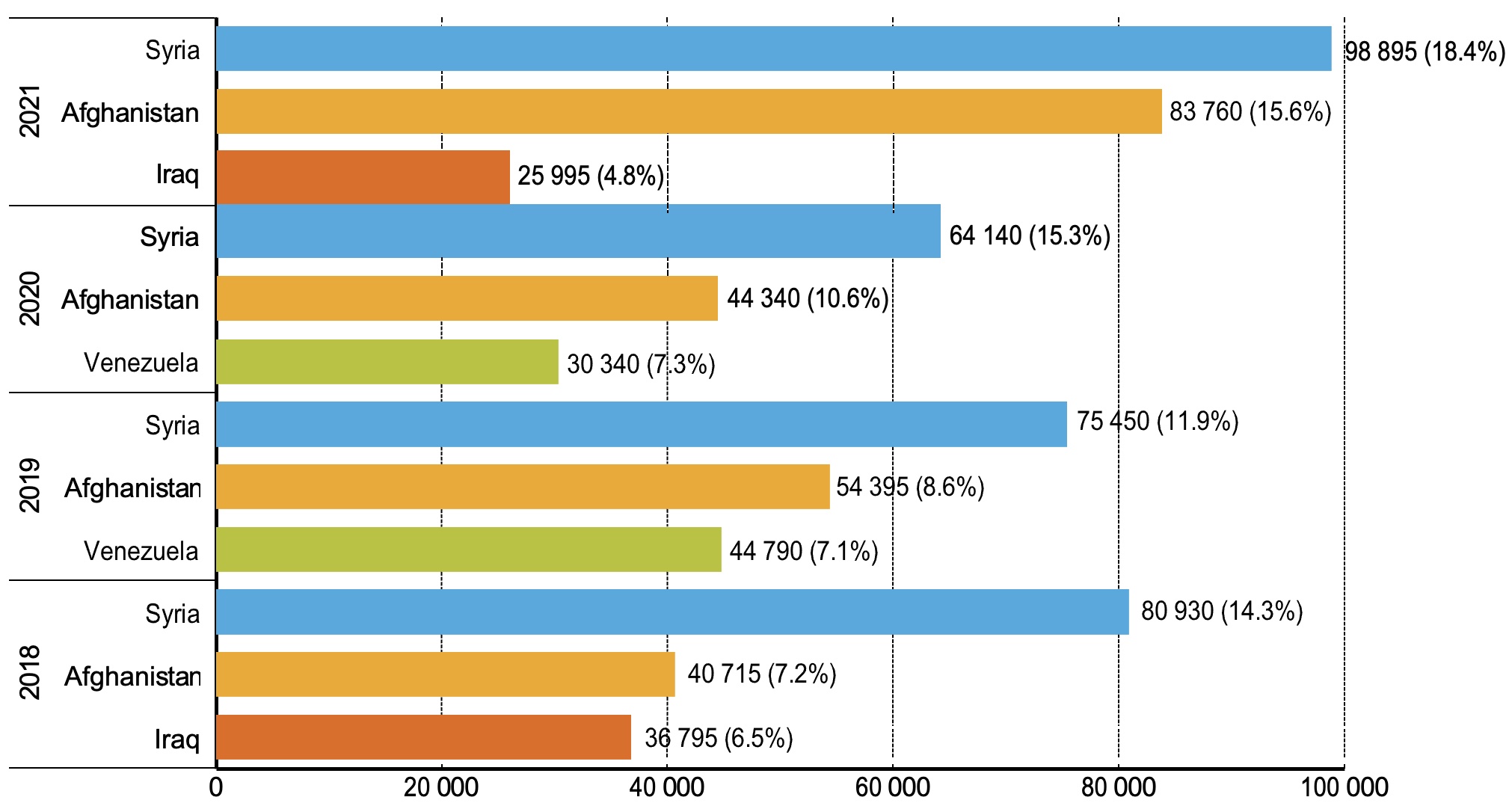
The main reasons for forced displacement are wars or situations of political conflict. Here we see how three countries in constant war or pseudo-war in recent years — Syria, Afghanistan, Ukraine, Palestine and South Sudan — occupy the top four positions in terms of displaced persons.
Top 3 nationalities of first-time asylum seekers in EU and Norway. Source: number and % of total first-time applications. Eurostat (migr_asyappctza)
Of course, political reasons are not the only ones that motivate migration. We could include factors such as the economy, globalised world trade, social and cultural ties, demographics, security, geography, proximity and one that is becoming increasingly important over the years: those affected by climate change.
Comparison with the past
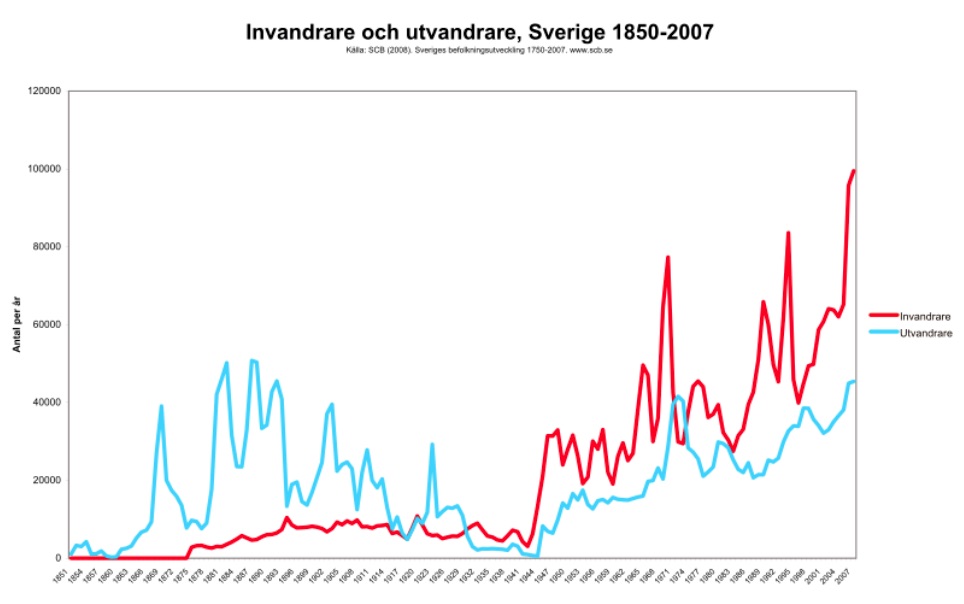
This whole picture shows an irrefutable truth: migration is currently experiencing an upward trend compared to the last 30 years. However, this increase must be put into perspective. When compared to other periods in history, the situation is not as alarming as some would have you believe.
For example, during the first great migration in the early 19th century, around 60 million Europeans emigrated to the American continent. The second great wave of the 20th century, which began after the Second World War, was no less significant, with millions of refugees and an increase in migration flows from a wide variety of places. And the world, despite everything, survived.
Evolution of migration in Sweden: in red, immigrants received, in blue, emigrants issued. 1851-2007. Source: Wikipedia.
Conclusion
Thus, when analysing the present, future direction and past of migratory movements, several conclusions can be drawn. On the one hand, it is a volatile phenomenon. When analysed from a historical perspective, it shows moments of boom and bust. And today we are experiencing an upward trend. However, the phenomenon of climate change may intensify it, as may wars and economic and geopolitical uncertainties.
This historical perspective helps us to avoid immediately sounding the alarm. Nevertheless, our globalised societies would do well to monitor certain factors — geopolitical, military and, above all, climatic — that could cause this dynamic to spiral out of control to unsustainable levels. What is clear is that there is still much work to be done.
Get an expert evaluation!
If you need help applying for a non-lucrative residence permit, a work permit and/or a student visa in Spain, book a 60-minute online consultation and receive useful advice to help you achieve this.
Abogada especializada en Derecho de Extranjería Español. Es el equilibrio del despacho y la piedra angular. Es una trabajadora en estado puro y gran compañera. Y… ¿sabéis qué? En sus ratos libres deja la seriedad sentada en el despacho y baila como los demás.
![[Hero] World Migrants Day: present, past and future](/images/c/adults-communication-cooperation-2422294.jpg)
![[FIG-1]](/images/b/fig-number-third-country-nationals-eurostat-2021.png)
![[FIG-2]](/images/b/fig-top-countries-whose-citizens-received-first-residence-permit-EU.jpg)